
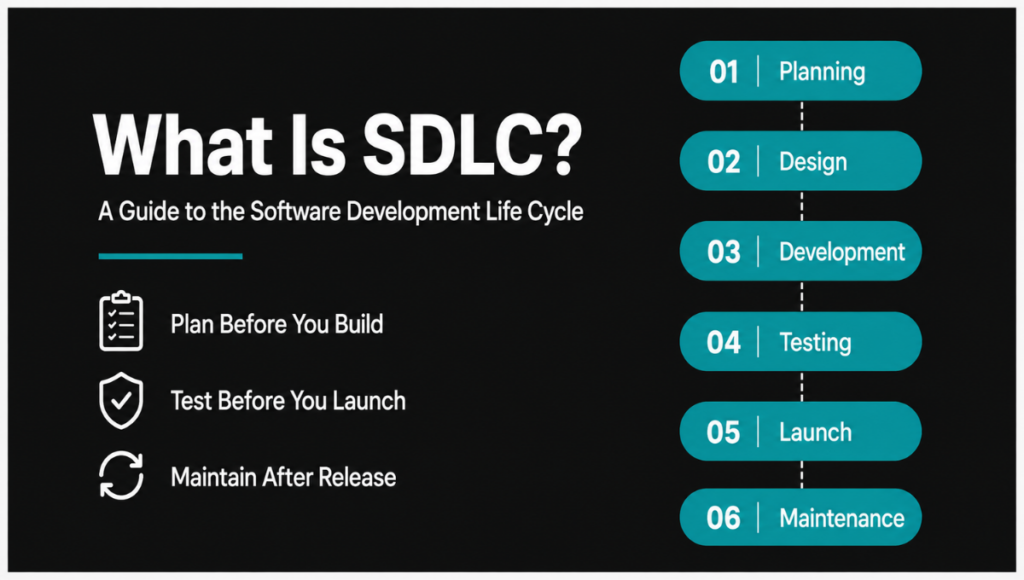
Summary: Every successful software development project goes through an established process called the software development life cycle (SDLC). In this article, you will learn what SDLC is, how each phase works, and why businesses select certain development models to create software fast and efficiently. This guide will be useful for a business owner who is going to create a new system, a startup founder in search of his/her first product, or a developer who is not aware of SDLC processes.
_______________________________________________________________
SDLC Explained: A Complete Guide to the Software Development Life Cycle
Software Development Projects | Types of Software Testing | Software Development Agency
Understanding the Software Development Life Cycle (SDLC)
Software Development Life Cycle is a series of steps that software development teams follow while developing applications. Software Development Life Cycle is a map that should be followed by any software development project to ensure completeness of the development process.
When asking yourself what is SDLC, imagine the process as a series of phases a software developer goes through to bring a project from conception to fruition. Each phase aims to reach a certain milestone and includes its own deliverables and review points. Skipping any stage can cause errors, delays, or even a failure to meet user expectations once the application hits the market.
To understand what is software development, one has to learn about this process, as it lies at the heart of any reliable software development process practiced by modern software teams.
Companies that practice the software development life cycle effectively introduce fewer defects and spend less time dealing with issues after releasing their software solutions.
How Does the SDLC Process Work?
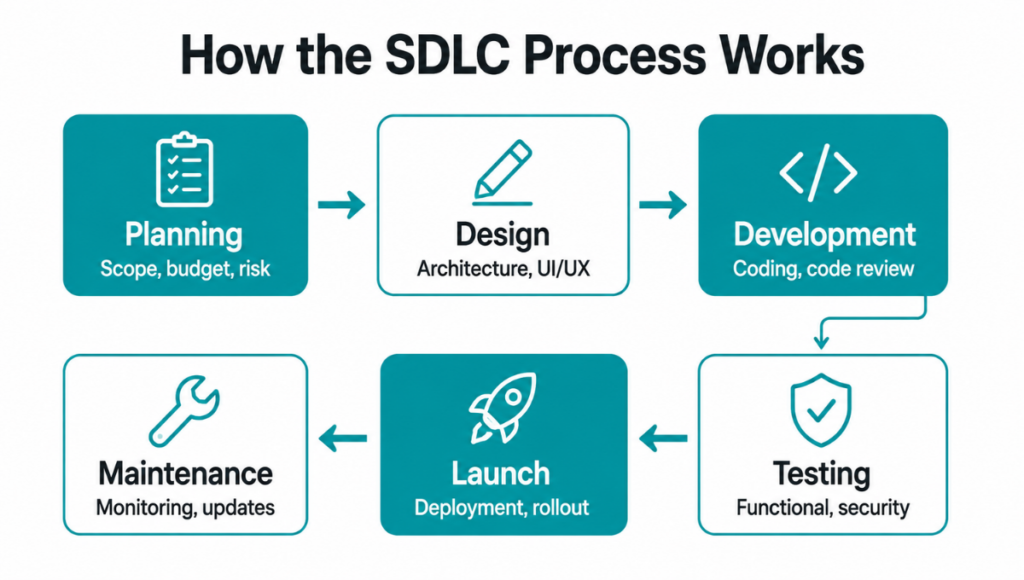
The process of the software development life cycle includes six SDLC phases, which come sequentially one after another and are necessary for creating a functional, tested, and ready-for-release product without spending extra time and budget on rework.
Planning the Project
The first phase of any successful software development process is Planning. At this stage, teams collect and analyze requirements, create project scope, and estimate budget and time for development without even starting the coding process. This phase is also important because the risks associated with the development process are identified and analyzed at this stage, allowing all further steps to proceed smoothly.
Effective planning provides the foundation for any software development project management process, as the decisions taken during the planning phase influence every other SDLC phase, including project team structure and technology stack choice.
At this stage, stakeholders are invited to give some feedback, as it is crucial for avoiding the creation of useless features.
Designing the Software
After the planning phase is over, teams proceed to Software design. At this stage, designers and developers think through such aspects as the structure of the database, technologies used for the creation of the application, system architecture, and communication between different application parts.
Also, UI design is carried out at this stage, as user experience has a great influence on users’ interest in the product. During the design phase, stakeholders have a chance to provide feedback and request changes.
The thorough design phase makes the next stages of the process cheaper, as correcting design flaws in the further development process becomes too costly.
Developing and Implementing the Solution
Most of the build occurs at this stage. At this phase, the software development team starts writing the code according to the chosen and approved design. Wireframes and specifications are transformed into code step-by-step.
In the case of mobile app development projects, at this stage, separate components of the application are created for each platform, but the core logic is kept similar.
During this phase, version control, coding standards, and code review processes are implemented.
Testing for Quality and Performance
No matter what, every project requires adequate testing to make sure that the product will work properly and live up to its potential when used by the customers.
There is a variety of types of software testing, such as functional, performance, security, and usability testing, among others, that test different aspects of its behavior. Besides, there is a software testing life cycle that should be followed strictly to ensure that nothing is forgotten prior to launch.
Proper software testing is vital for a business to avoid possible post-launch fixes, loss of customers, and harm to the company’s image.
Launching the Software
Once the testing procedure is completed successfully, the next stage of the software development life cycle is its launch. This stage includes making the software product available to real users, either via app stores, web deployment, or a company-wide deployment across all departments.
Successful launch depends on all activities performed at previous stages of the software development process. Launch is usually managed strictly by businesses providing software development services, at least for the first several days.
Maintaining and Improving the Software
However, development doesn’t have to stop once software launches. Teams monitor its performance, fix problems, and release updates based on user experience and data collected after release.
Checking the software development life cycle phases regularly is quite important at this stage, since it is as significant as the rest of them and may last for years. It becomes much easier to maintain the product in such cases by working with a custom software development company.
What are the Different SDLC Models?
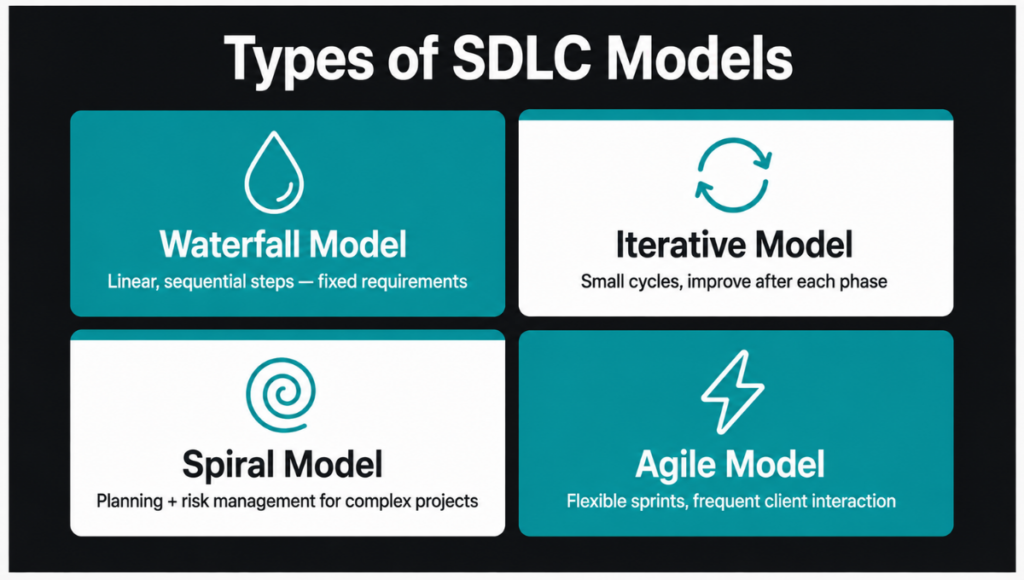
The application of the software development life cycle differs among the teams working in the industry. There are many SDLC models to choose from, which fit best for different projects, project periods, budgets, and team sizes. That is why choosing the appropriate model plays a crucial role in the software development process.
Waterfall Model
The Waterfall model is one of the traditional models in software development. It follows a linear process where teams implement each step sequentially, resembling the flow of water in a series of waterfalls.
>This model suits software projects with fixed requirements and scope, but it leaves little room for modifications once a phase is complete.
Iterative Development Model
The Iterative Model is a software development process which consists of several smaller cycles. Each cycle develops some version of the software and allows making improvements after each implementation phase. This approach works well when requirements are likely to change, and development teams don’t have all the details upfront.
Spiral Model
Another model in software development is the Spiral Model, which combines planning and risk management with cycles of development and provides a possibility to evaluate the risks after each step of the build.
This model is mostly applied to big and complex software projects when it is needed to identify risks and decrease costs.
Agile Development Model
One more SDLC model is the Agile Model. Its main idea is flexibility, collaborative work, and short cycles of development called sprints. In most cases, these sprints take one to four weeks to complete.
Today, many consider it the most popular SDLC model because of its flexibility and frequent interaction with clients.
How is SDLC Different From Other Lifecycle Approaches?
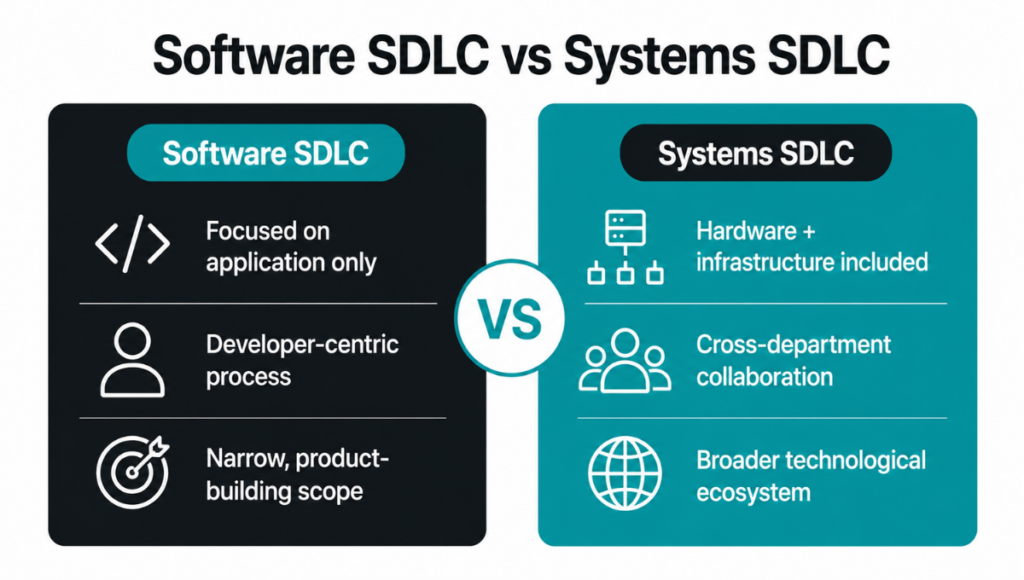
Although SDLC is very popular, people often mix it up with other frameworks that share similar terminology but differ in purpose and process.
What is the Systems Development Life Cycle?
The Systems Development Life Cycle (SDLC) framework involves not only software but all hardware components as well as the infrastructure, network connections, and processes within an organization. It is very popular within large companies that develop complex integrated systems that require collaboration of various departments.
This makes it possible to plan the development process more accurately, as it is always necessary to take into account that a system does not exist in a vacuum and interacts with other processes, people, and hardware.
SDLC vs. Systems Development Life Cycle: What’s the Difference?
The Application Development Life Cycle (ADLC) focuses on creating an application. The Systems Development Life Cycle (SDLC) covers the whole technological ecosystem — hardware, infrastructure, processes, and software. There’s no conflict between SDLC and ALM. In fact, many companies use both frameworks together to cover the software side of a larger systems development project.
What Is Application Lifecycle Management (ALM)?
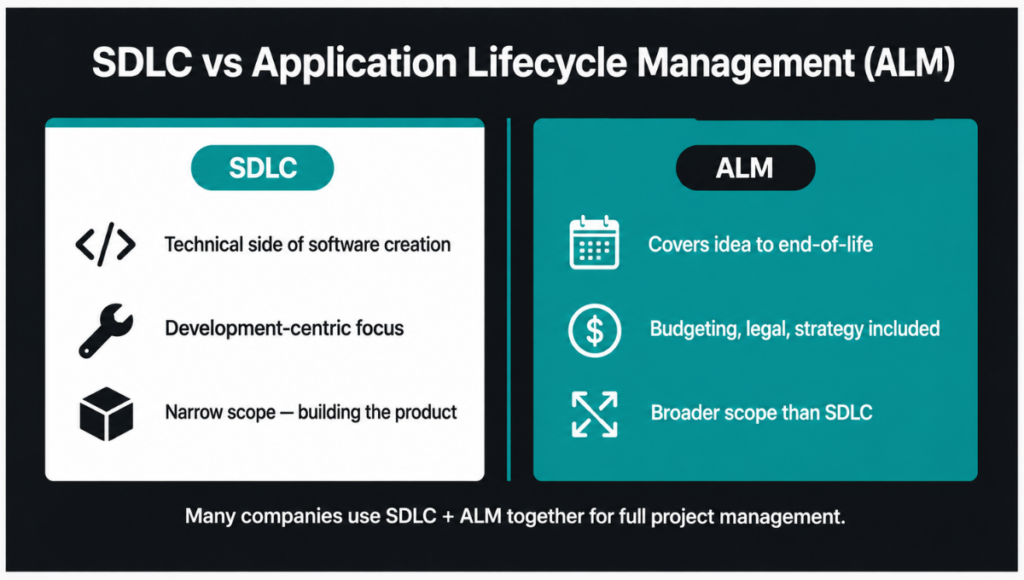
People sometimes mistakenly confuse Application Lifecycle Management (ALM) with SDLC. ALM covers every stage of a software product’s existence. It starts with the initial idea and continues through to the final phase. This framework is wider than SDLC. It covers not just development, but every other aspect of the software lifecycle.
SDLC vs. ALM: Key Differences
SDLC focuses mostly on the technical side of software creation. ALM takes a broader view, factoring in budgeting, legal regulations, and even strategy. There are a lot of companies using SDLC and ALM together for the sake of software development project management.
Understanding the boundaries between these frameworks allows you to allocate responsibilities properly and avoid confusion during project execution.
How Dev Mondiale Can Help With Your Software Development Needs
We at Dev Mondiale will help any company based in Saudi Arabia to go through all SDLC stages, from planning to post-launch support. Our services include all types of software development, including custom software development, mobile app development, and software testing. We will provide all kinds of assistance to make your product run smoothly from the first day.
From building a completely new software product to managing ongoing development for your current ones, we’ve got you covered. Our experienced software developer team is ready to assist you with all your needs.
Final Thoughts on the Software Development Life Cycle
Building good software takes a clear, step-by-step process. You plan, test, and complete each stage with defined checkpoints along the way. This understanding helps companies set realistic timelines and avoid costly mistakes. More importantly, it results in a product that actually serves its users, not one built just to hit a deadline.
The methodology you choose matters here. A proper work structure is what separates rushed, shaky projects from reliable solutions that hold up long after launch. Companies willing to invest time upfront in their process end up saving far more time and money later. That’s because they spend less energy fixing problems after the fact.
If you want to explore these concepts further, check out our blog for more insights on software development best practices. To discuss how we can help structure and execute your next software project, feel free to contact us today.
Frequently Asked Questions
What is the primary purpose of the SDLC?
It provides a clear structure for the development process, which includes planning, building, testing, and maintenance of the software.
Which SDLC model is most suitable for software development?
It all depends on the specifics of each particular project. Projects that require more flexibility and constant updating of the product will need an iterative or collaborative approach rather than a linear one. Discussion with professionals will help you understand which model is better for you.
How many steps are there in the SDLC process?
There are 6 main steps in the SDLC process, including planning, designing, development, testing, release, and maintenance. Some models may include repetitions and combinations of these steps.