
Modern AI applications are being revolutionised by machine learning (ML), which allows software to learn from data and get better over time without explicit programming. ML enables more intelligent, adaptable systems, ranging from personalized recommendations and predictive analytics to driverless cars and smart assistants. It improves user experiences, accuracy, and efficiency across industries by identifying trends and using data to inform decisions. Machine learning continues to be the foundation of AI’s ongoing development, spurring innovation and influencing the direction of intelligent software solutions.
How Machine Learning is Transforming AI Applications and Software?
AI Chatbot | AI Tools | Neural Networks
The combination of artificial intelligence (AI) and machine learning (ML) is fostering incredible innovation in software, applications, and business operations in the current digital era. In fields like software development, mobile app creation, and customer support services, this synergy is revolutionising how systems are created, decisions are made, and value is delivered. Examples of this include neural networks, which enable sophisticated image recognition, and natural language processing (NLP), which powers intelligent chatbots.
This article will examine:
- The definition of machine learning and how it relates to AI.
- Important machine learning types, methods, and algorithms, along with the distinctions between deep learning and conventional ML.
- Real-world uses of AI and machine learning in chatbots, robotic process automation, software development, mobile apps, and other fields.
- How this evolution is being supported by AI frameworks and data-driven decision-making, including AWS-certified machine learning services.
- The advantages, difficulties, and general contribution of AI to the development of contemporary technology and business solutions.
What is Machine Learning?
Machine learning (ML) is a subfield of artificial intelligence in which algorithms are not explicitly programmed for every situation; instead, they learn patterns from data to make predictions or decisions. Machine learning is a subset of AI focused on algorithms that analyse and ‘learn’ the patterns of training data to make accurate inferences about new data, according to IBM.
To put it another way, developers build models that learn from examples rather than manually coding each rule. Software can scale, evolve, and adapt to a variety of applications with this method.
Important things to think about:
Data-driven Choices
The calibre, volume, and applicability of the training data have a significant impact on how well a machine learning model performs.
Neural Networks
These are frequently used for complicated tasks like speech recognition, image recognition, and sequential data analysis.
Adaptive Intelligence
AI and software systems can become smarter, more independent, and able to change over time thanks to machine learning.
Types of Machine Learning & Basic Algorithms
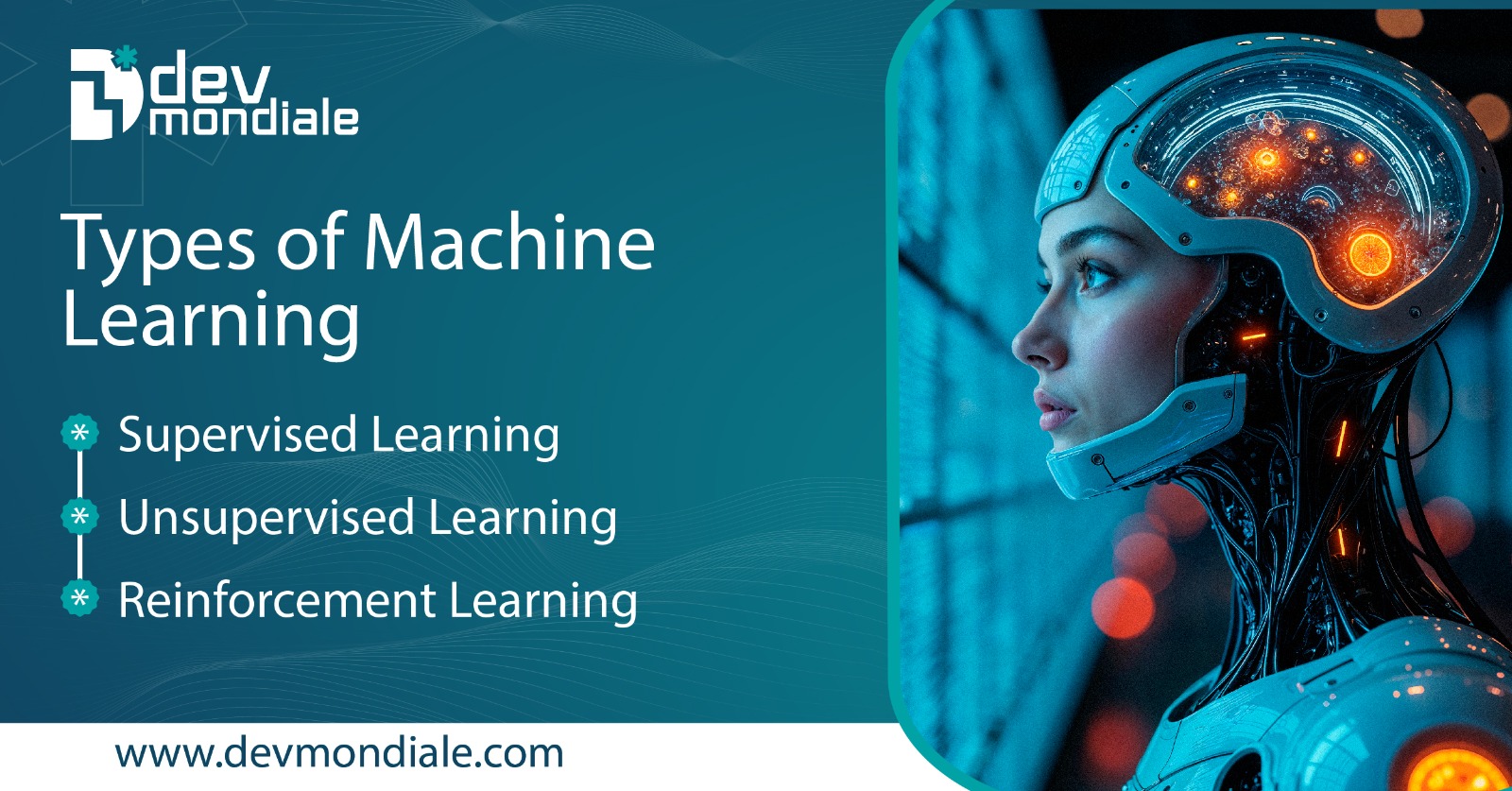
A variety of machine learning algorithms are used in machine learning, which can be divided into main types (or paradigms). Leveraging the appropriate approach requires an understanding of the differences.
Supervised Learning
To teach models to map inputs to outputs, they are trained on labelled data (input → known output). Training a classifier to identify spam is one example.
Unsupervised Learning
Without any explicit output values, models discover patterns in unlabelled data. For instance, grouping users according to their behaviour.
Reinforcement Learning
When models engage with their surroundings and get feedback—such as rewards or penalties—they learn. Frequently seen in games or robotics.
Machine Learning Basic Algorithms & Techniques
The following are some fundamental machine learning algorithms and methods:
- Both supervised logistic regression and linear regression
- Random forests and decision trees
- SVMs, or support vector machines
- Unsupervised K-means clustering
- Using principal component analysis (PCA) to reduce dimensionality
- Deep learning architectures and neural networks (such as recurrent and convolutional neural networks)
- Ensemble techniques such as boosting (XGBoost, for example)
- Feature extraction and feature engineering
- automated machine learning (AutoML) methods that automate pipeline design and hyper-parameter tuning.
Deep Learning vs. Machine Learning
It’s critical to understand how deep learning differs from conventional machine learning.
- The broader concept of learning from data is known as machine learning.
- Using deep neural networks (many layers), deep learning is a subset of machine learning that learns hierarchical data representations.
- IBM claims that “data science and machine learning are closely related fields. Deep learning, a branch of machine learning powered by massive, or more accurately, ‘deep,’ artificial neural networks, has become the cutting edge of architecture.
- In other words, “traditional” machine learning can be adequate for simpler tasks requiring less data and less computing power. In contrast, deep learning is suitable for large-scale, extremely complex data (such as images, speech, or text).
AI Tools, AI Frameworks, and Machine Learning Services
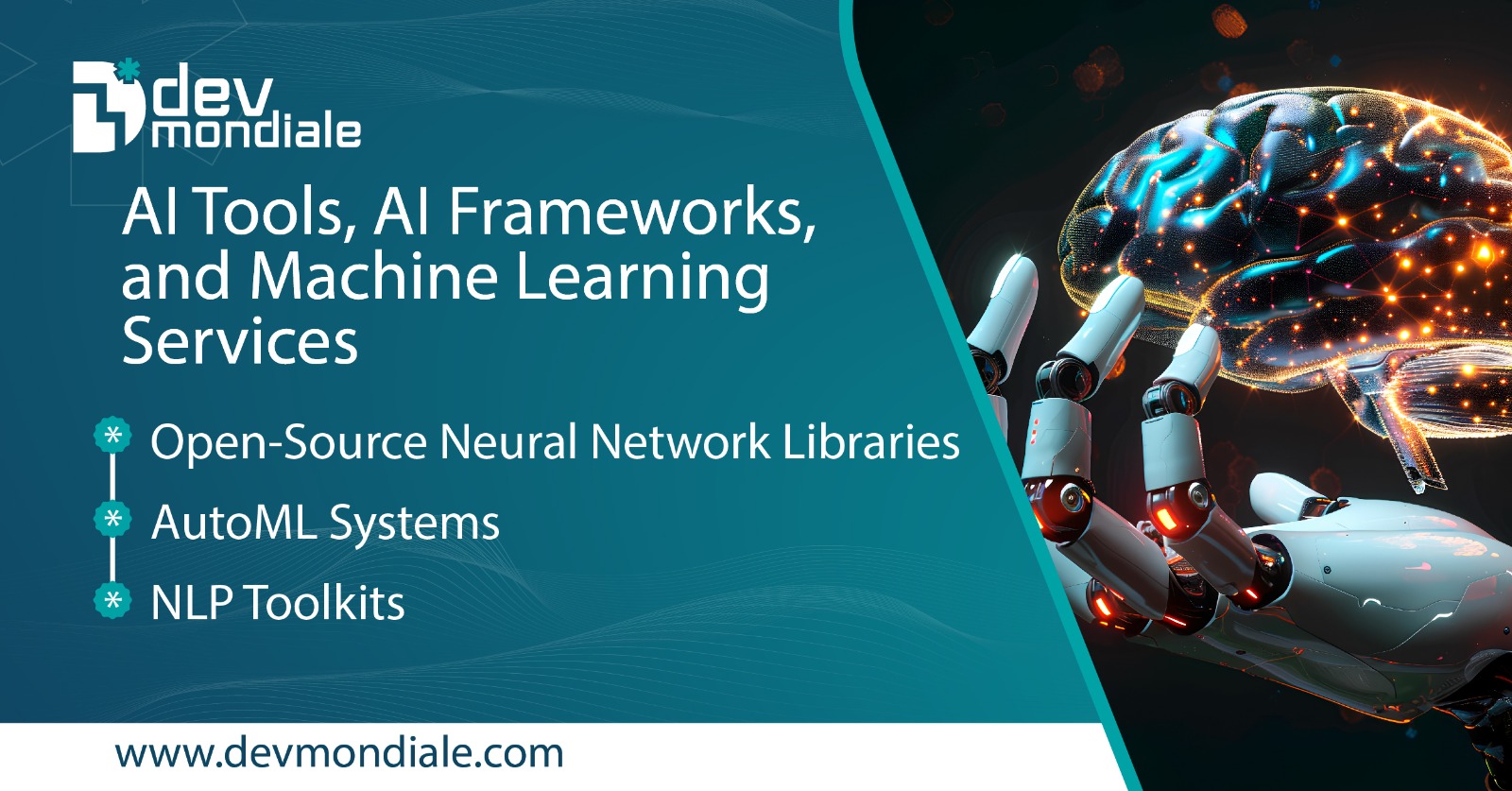
Developers use AI tools, AI frameworks, and machine learning services to support AI and machine learning applications. These make development, deployment, monitoring, and experimentation easier.
Typical tools and frameworks consist of:
- Open-source neural network libraries include PyTorch and TensorFlow. Wikipedia
- AutoML systems that eliminate the need for manually creating features or hyperparameters.
- NLP toolkits, such as HuggingFace Transformers and spaCy, are utilized to develop language-aware systems and conversational agents.
Cloud Platforms & Machine Learning Services
Major cloud providers provide machine learning services:
- SageMaker is one of the Certified Machine Learning programs and services offered by Amazon Web Services (AWS).
- Microsoft Azure Machine Learning, Google Cloud AI Platform, etc. Scaling AI/ML processes, managing data pipelines, training models, deploying endpoints, and tracking performance are all made possible by these services.
Software development teams can concentrate on business logic rather than infrastructure and incorporate machine learning into their workflows more rapidly by utilising such services.
AI Chatbots, Natural Language Processing, and Neural Networks
Machine learning has enabled AI applications to create obvious changes, including natural language processing (NLP) and neural network-powered AI chatbots.
AI Chatbots
Rule-based scripts are just one aspect of modern chatbots. To comprehend user intent, preserve context, produce responses, and gain knowledge from interactions, they employ ML models. For instance:
- Customer service chatbots may categorise user intent (e.g., “billing query,” “technical problem”) and route accordingly.
- Neural networks and NLP frameworks can be used to create conversational agents that can interact at nearly human levels.
Natural Language Processing (NLP)
The area of AI known as natural language processing (NLP) gives machines the ability to comprehend, produce, and react to human language. Machine learning algorithms enhance natural language processing by enabling tasks such as tokenization, named entity recognition, sentiment analysis, translation, and conversation. Systems improve through data and interactions when these algorithms are applied.
Neural Networks
Many contemporary AI applications rely on neural networks, particularly deep neural networks, as their computational engines. They learn latent representations, extract features, and process complex inputs. Developers commonly use recurrent neural networks (RNNs), transformers, and attention-based networks in NLP and chatbots. Neural networks, NLP, and ML algorithms work together to create chatbots and conversational AI tools that transform how companies engage with their customers by enhancing software’s intelligence, adaptability, and user-centricity.
Software Development, Mobile App Development & AI Applications
Beyond chatbots, machine learning and artificial intelligence have a significant impact on software development, mobile app development, and a variety of other AI applications.
Software Development
There are several ways that ML is being incorporated into software development:
- Incorporating anomaly detection, personalisation, or predictive analytics straight into software modules.
- Accelerating the creation of intelligent features with AI frameworks and SDKs.
- Automating the development lifecycle includes automated testing (e.g., through AI tools), bug prediction, and code completion suggestions.
- Switching to data-driven, adaptive systems from conventional rule-based software.
Mobile App Development
Mobile apps increasingly incorporate ML and AI:
- Music, video, and product recommendation engines that pick up on user preferences and behaviour.
- AI inference for on-device applications such as voice assistants, augmented reality, and image recognition.
- We use neural networks and ML algorithms to deliver context-aware and personalized experiences.
AI Applications
In general, a diverse range of AI applications is being made possible by ML:
- AI-assisted image analysis, diagnostics, and patient outcome prediction in healthcare.
- In finance, Algorithmic trading, risk modelling, and fraud detection.
- Logistics Supply-chain optimisation, dynamic routing, and predictive maintenance. codora.io
- AI chatbots, sentiment analysis, and auto-response systems are used in customer service.
- Intelligent workflows, collaborative robots, and the automation of repetitive tasks are all examples of robotics and robotic process automation (RPA).
Robotic Process Automation (RPA) Meets Machine Learning
Robotic process automation traditionally handled repetitive, rule-based tasks, such as data entry and invoice processing (RPA). RPA becomes intelligent automation when paired with ML; the bots learn from data, make choices, and adjust.
For instance:
- Utilising NLP and machine learning to extract data from unstructured documents (such as invoices and forms) and then automating processes.
- Bots that automatically initiate exception workflows, track transaction patterns, and identify anomalies.
- Consequently, machine learning enhances RPA’s capabilities, increasing the autonomy and scalability of AI applications.
Data‑Driven Decision Making
Data-driven decision-making is essential to this change. Organisations can use ML to make decisions based on patterns found in large datasets rather than relying solely on intuition or static rules.
Among the essential elements of data-driven decision making are:
- Gathering and organising vast amounts of data (big data).
- Utilising ML algorithms to generate predictions, insights, and suggestions.
- AI tools, software, and procedures use these insights to make decisions automatically or with minimal human assistance.
- Constant observation and feedback loops: systems improve their performance and choices as they gain knowledge from fresh data.
With this strategy, businesses can:
- Customise interactions (mobile apps, customer service)
- Streamline processes (manufacturing, logistics, supply chain)
- Create novel goods and services (AI applications based on deep learning, neural networks, and natural language processing).
Role of Artificial Intelligence and Machine Learning in the AI Transformation
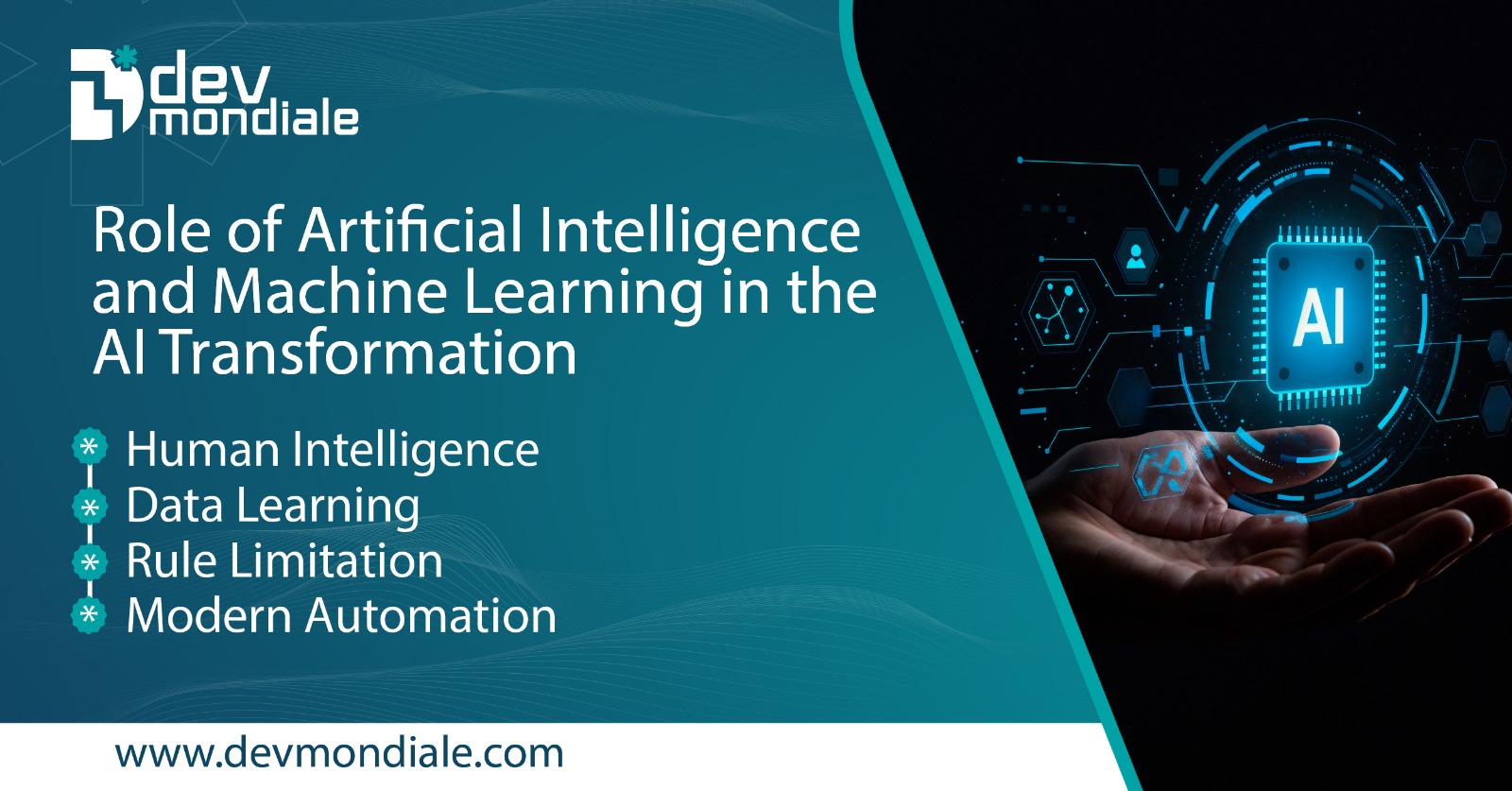
Machine learning is quickly changing the role of artificial intelligence (AI) in software and applications today. Let’s examine their relationship and the roles they each play.
- AI is the more general term for systems that can carry out tasks that typically call for human intelligence, such as language comprehension, recognition, and decision-making.
- Machine learning powers a large portion of contemporary AI by enabling systems to learn from data, adapt, and improve over time.
- In summary, machine learning makes it possible for AI systems to be adaptive, scalable, and constantly improving, whereas AI without ML frequently depends on strict rules.
- To produce intelligent behaviour, today’s AI software and applications mainly rely on machine learning(ML) techniques (algorithms, neural networks, and deep learning).
Benefits of Machine Learning(ML) in AI Applications & Software
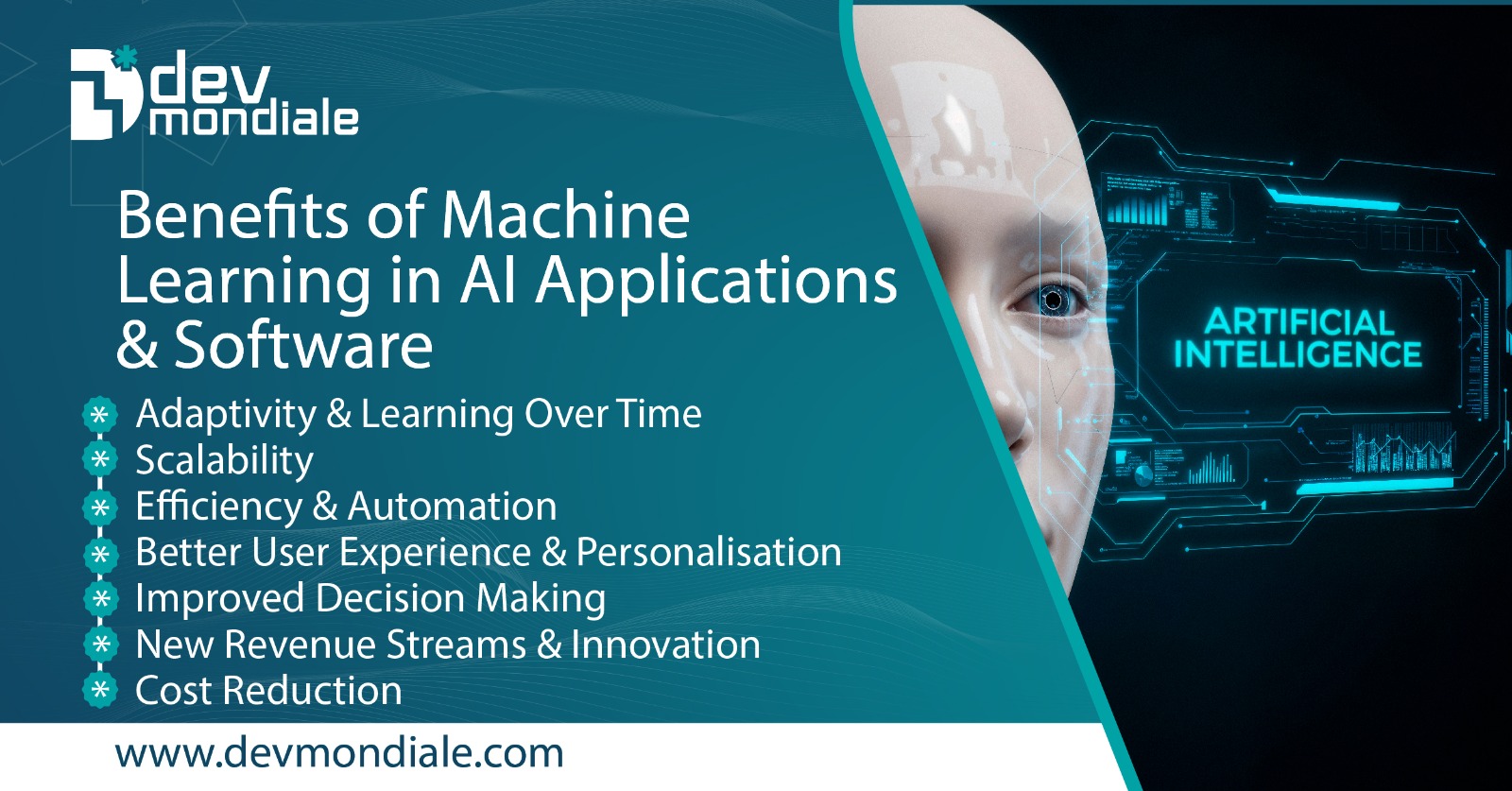
Effectively incorporating ML into AI software and applications provides the following main advantages:
- Adaptivity & Learning Over Time: Machine learning algorithms enable systems to get better as more data becomes available.
- Scalability: Models generalise across numerous use cases instead of requiring manual coding rules.
- Efficiency & Automation: Chatbots decrease human labour and expedite response times in domains like customer support services.
- ML customises software and mobile apps to match each user’s preferences, creating a better and more personalised experience.
- Improved Decision Making: Organisations can reduce risk, improve forecasting, and obtain deeper insights by using data-driven decision-making.
- New Revenue Streams & Innovation: ML-powered AI applications create new goods, services, and business models.
- Cost Reduction: ML and robotic process automation reduce errors and costs.
Because of these advantages, businesses from a variety of sectors are making significant investments in AI frameworks, machine learning(ML) services, neural networks, mobile app development, and software development that integrates these technologies.
Dev Mondiale: Using Intelligent Software to Foster Innovation
Converting concepts into intelligent digital experiences is our passion at Dev Mondiale. In our most recent article, “The Importance of Artificial Intelligence in Building Smarter Software Solutions,” we examine how AI is transforming software development, design, and performance optimisation for the real world. We assist companies in adopting more intelligent, flexible solutions that boost productivity and creativity by utilising state-of-the-art technologies and data-driven insights. About Us: Dev Mondiale is a progressive software development firm committed to providing scalable, high-performing digital solutions driven by AI. Our goal is to equip companies all over the world with technology that fosters expansion, innovation, and long-term success.
Conclusion
The core of contemporary artificial intelligence is ML, which is redefining the way software and applications work and spurring innovation across industries. ML is revolutionising the future of technology by giving systems the ability to learn, adapt, and make wise decisions. This includes automation, predictive analytics, and personalised user experiences. Building intelligent, AI-powered software solutions that meet your company’s needs is our specialty at Dev Mondiale. To help you stay ahead in the digital age, our team combines experience in software development and data analytics. Reach Out to Us: Are you ready to integrate ML and artificial intelligence into your software? Contact Dev Mondiale right now, and together, let’s create the smart technology of the future.
FAQs
What role does ML play in software development?
By automating testing, enhancing code quality, and forecasting user behaviour, ML improves software development efficiency. Additionally, it aids developers in producing adaptive apps that change in response to user input and real-time data.
Which sectors gain the most from ML?
There are significant advantages for sectors like technology, healthcare, banking, retail, and transportation. ML makes systems smarter and more effective by enhancing automation, fraud detection, diagnostics, and customer insights.
In contemporary AI applications, what function does ML serve?
Modern artificial intelligence is built on ML, which enables systems to analyse data, identify patterns, and generate insightful predictions. It makes it possible for a variety of applications, including chatbots and self-driving cars, to be automated, personalised, and to make better decisions.